
Can You Trust the Insight? Healthcare Market Research in the AI Era
Healthcare market research can influence which patient needs a company prioritises, how it positions a device and where it investigates barriers to adoption. Before acting on a recommendation, a decision-maker needs to understand the evidence behind it.
That becomes especially important when AI helps turn interviews and survey responses into findings. A clear summary can be useful, but clarity alone does not establish that the interpretation is complete or appropriate.
World Standards Day 2026, observed on 14 October, offers an opportunity to examine what makes research trustworthy. The occasion recognises the experts who develop international standards. For the insights profession, it also invites a practical question: how should established responsibilities carry through into new research methods?
In his World Standards Day article for Research World, ESOMAR’s Xabier Palacio explores the relationship between standards, innovation and trust. In healthcare, that relationship becomes tangible at every stage between a participant’s contribution and a business recommendation.
Why standards matter in healthcare market research
Consider a hypothetical device adoption study. Physicians describe training needs, patients discuss confidence in using the product, and procurement teams explain purchasing constraints. If these perspectives are combined into one broad “adoption barrier” theme, the resulting recommendation may obscure who needs what.
The research has to preserve distinctions that matter to the decision. A patient’s difficulty using a device, a clinician’s concern about workflow and a purchaser’s budget constraint require different responses.
Standards give researchers and clients a shared basis for discussing how evidence is collected, handled and reported. They help make responsibilities explicit across agencies, fieldwork partners, technology suppliers and commissioning teams.
ISO 20252:2026, published in September 2026, is the fourth edition of the international standard covering service requirements for market, opinion and social research, including insights and data analytics.
Alongside it, the ICC/ESOMAR International Code provides an ethical framework. These instruments serve different purposes: a service standard addresses research delivery requirements, while an ethical code establishes professional responsibilities.
Trust begins with the people behind the data
A reliable analysis starts with appropriate participation. For an HCP study, researchers need eligibility criteria relevant to the question: specialty, treatment experience, practice setting or decision-making responsibility. Patient research needs equally thoughtful inclusion criteria and consideration of participants’ circumstances.
Participation should be voluntary and based on clear information. The ICC/ESOMAR Code addresses these principles, alongside data minimisation and special care for vulnerable individuals.
In practice, research teams should explain what participation involves, who can access identifiable information and how information will be used. Data shared with analysis suppliers should be limited to what the agreed work requires.
Healthcare also has sector-specific considerations. EPHMRA’s standards resources include a healthcare research Code of Conduct and adverse event reporting guidance. Where applicable, teams should establish the relevant reporting process before fieldwork.
These controls help protect participants and clarify the boundaries of the project. Commercial insight generation must remain distinct from promotional activity and clinical investigation.
What research tells us about AI-assisted analysis
Published studies suggest that AI can support qualitative analysis, while also showing why outputs deserve scrutiny.
A 2024 study in the Journal of Medical Internet Research compared GPT-4 with human researchers analysing interviews with 20 patients with adult-acquired buried penis. The researchers reported moderate agreement between human and AI coding, with a Cohen’s kappa of 0.401. Human analysis captured a richer variety of subthemes.
This was a small study involving one condition and a particular model and workflow. It does not establish today’s AI performance across healthcare market research. It does illustrate a relevant distinction: recognising a broad theme and preserving its underlying detail are different analytical tasks.
A 2026 study in JMIR Medical Informatics tested three models and five workflow strategies across three qualitative health datasets. Performance depended on both model choice and workflow design. The authors supported using models as human-supervised analytical assistants.
For research buyers, the implication is practical: ask how the proposed process has been evaluated for the work it will perform. A model name alone provides too little information about analytical quality.
Language and culture can change the interpretation
International research adds another layer of responsibility. A participant’s meaning may depend on language, local practice or an emotional expression that is difficult to interpret outside its context.
A 2025 Japanese healthcare study compared ChatGPT and human thematic analysis of 30 interviews. The analysis found stronger performance on explicit themes and difficulties with some culturally and emotionally nuanced meanings.
The findings are specific to that dataset and approach. They nevertheless support reviewing contextual interpretation when using AI in multilingual research.
For example, a hypothetical statement such as “we usually manage” might express confidence, resignation or reluctance to criticise a service. Researchers should examine the surrounding discussion before assigning meaning.
Local review, terminology checks and access to the original transcript can help resolve ambiguity. For businesses working across different therapeutic areas, these distinctions can affect how findings inform communication or service design.
Responsible AI requires visible human accountability
Human oversight should describe identifiable work. Who checks the transcript? Who reviews codes and themes? Who investigates conflicting accounts? Who approves the recommendation?
The ICC/ESOMAR Code requires clients to be informed about AI use in dataset compilation, analysis, reporting or interpretation, with the extent of human oversight stated. It also addresses confidentiality when research materials are used with AI.
A practical implementation is to document which tasks AI performs, retain connections between findings and supporting evidence, and review outputs for omissions or unsupported interpretation.
Researchers should also preserve disagreements and exceptions. A recurring issue in a qualitative sample may deserve attention, but it does not automatically establish its prevalence across a market.
Five questions healthcare research buyers should ask
ESOMAR’s AI supplier checklist supports practical due diligence. For healthcare projects, the following questions translate that principle into commissioning decisions: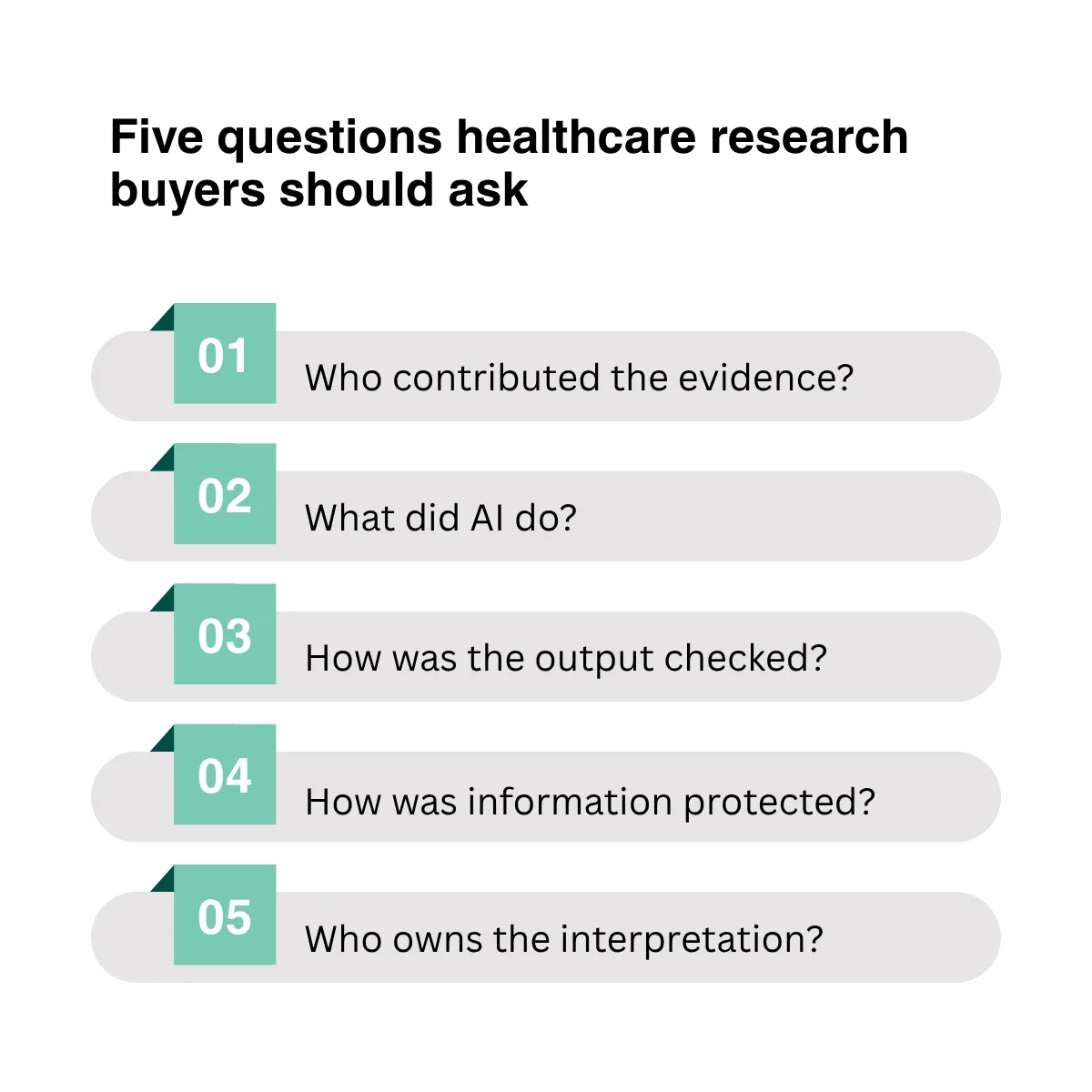
- Who contributed the evidence? Ask how eligibility was checked and which relevant perspectives the sample may exclude.
- What did AI do? Establish its role in transcription, translation, coding, analysis or reporting.
- How was the output checked? Ask for the validation approach and how contextual meaning and contradictory evidence were reviewed.
- How was information protected? Clarify access, retention and whether suppliers may use research material for other purposes.
- Who owns the interpretation? Identify the researcher responsible for connecting findings to recommendations and explaining their limits.
These questions make quality discussable before the final presentation. They also help buyers compare research approaches on more than speed and output volume.
Putting standards into healthcare business decisions
World Standards Day is an opportunity to examine whether research practices support the confidence placed in their results.
AI creates useful possibilities for organising and exploring evidence. Those possibilities become more valuable when clients can understand how a finding was produced and why it supports a particular decision.
At FMR Global Health, our qualitative and quantitative healthcare market research helps organisations explore patient and HCP needs, stakeholder journeys, communication, product concepts and adoption barriers. FMR does not conduct clinical research.
Whether a project uses established methods or AI-assisted analysis, the essential question remains: can the evidence support the decision being proposed?