

The 5.7-Year Trap in MedTech Market Access: Why Devices Can Stall After FDA Authorization, and 5 Steps to Take Earlier
FMR Global Research | Policy information checked: 5 October 2026
MedTech market access can remain unresolved long after FDA authorization. A company may be ready to manufacture, sell and train clinicians while still facing unanswered questions about coverage, billing and provider adoption. For emerging businesses, those uncertainties can put pressure on launch forecasts, funding plans and commercial priorities.
A 2023 study in JAMA Health Forum estimated a 5.7-year median from FDA authorization to at least nominal Medicare coverage for a selected cohort of novel technologies. That finding deserves attention, and a precise explanation.[1]
The practical response is to investigate evidence and access requirements while development decisions can still change. Early evidence generation can address avoidable gaps, although the available studies do not establish a guaranteed reduction in time to coverage.
What the 5.7-year figure actually measures
The researchers studied 64 novel devices and diagnostics authorized between 2016 and 2019 that needed a new Medicare pathway. By the end of 2022, 28 approximately, 44% had reached at least nominal coverage. The 5.7-year figure was a time-to-event estimate, rather than an average wait for every FDA-authorized device.[1]
“Nominal coverage” also differs from nationwide reimbursement, routine adoption or meaningful revenue. The cohort’s estimated five-year coverage probability was lower for small companies than large ones: 19.4% versus 67.9%. This association does not establish why the difference occurred.[1]
A separate original survey of 253 innovators and 83 investors reported an average estimated 4.7 years to nationwide Medicare coverage. Those responses came from a voluntary sample and described recalled or estimated timelines. They support concern about access uncertainty, but should not be combined with the JAMA study as if both measured the same outcome.[2]
Why MedTech market access can stall after authorization
FDA authorization and payer coverage involve different decisions. FDA explicitly notes that the evidence supporting authorization may not overlap with the evidence payers need for coverage.[3] A development team therefore needs to identify each stakeholder’s questions before assuming one study will answer them all.
It also helps to separate four commercial requirements:
- Coverage: whether a payer will cover the technology for specified patients and circumstances.
- Coding: how the service or technology is identified when claims are submitted.
- Payment: the applicable payment mechanism and amount.
- Adoption: whether providers can implement the technology within their budgets and workflows.
These requirements interact, but progress on one does not settle the others. For example, Medicare’s hospital outpatient payment system packages some items into payment for the primary service. A device’s availability therefore does not automatically mean a separate payment covers its acquisition and use.[4]
For leadership teams, the risk is a launch plan built around an untested assumption: that authorization will immediately translate into accessible, economically viable use.
5 early evidence steps for a stronger access plan
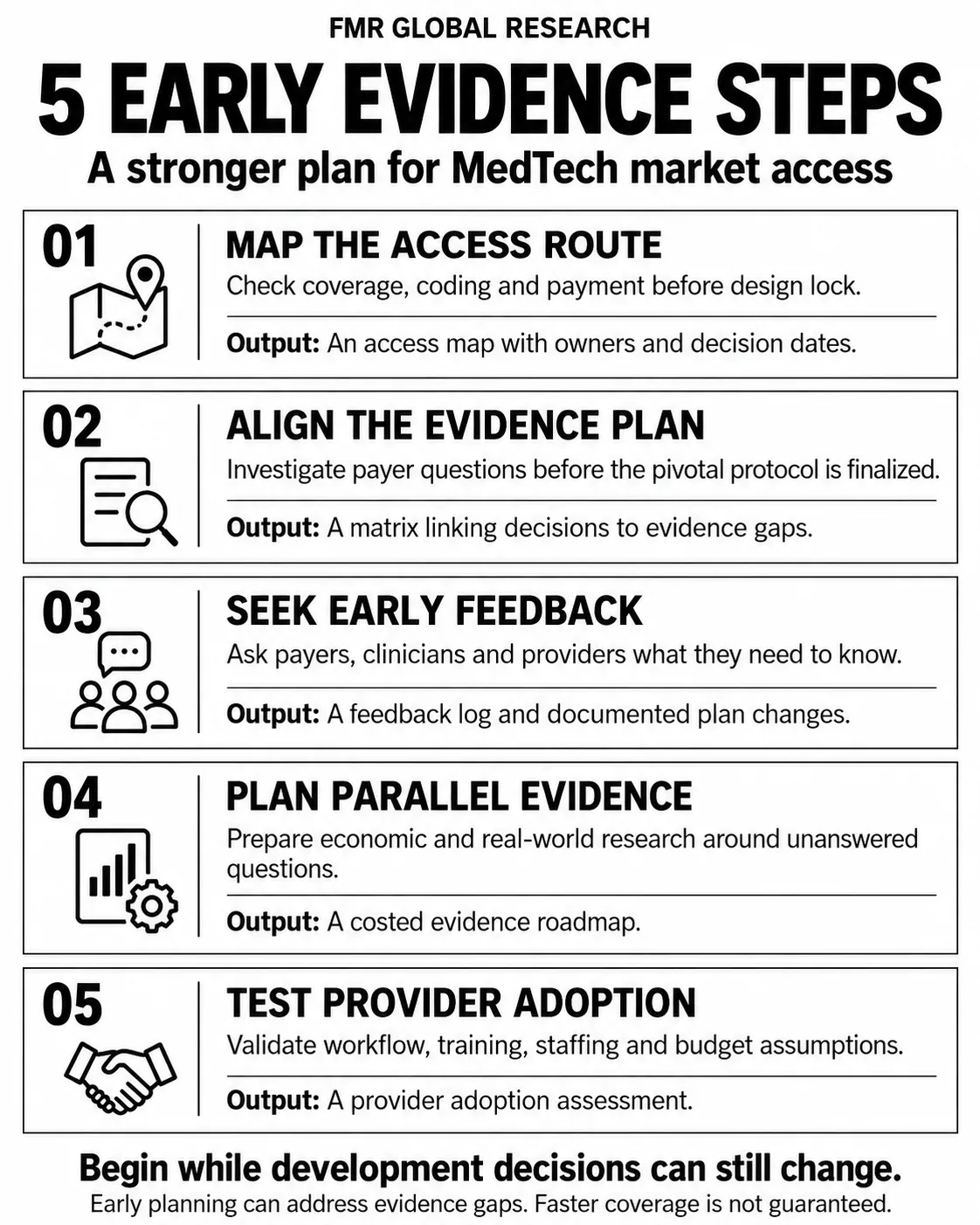
Step 1: Map coverage, coding and payment before design lock
Begin with the intended indication, patient population and care setting. Investigate whether existing coverage policies and codes apply, whether a new route may be needed and which assumptions require specialist review. CMS describes multiple coverage mechanisms, including national and local determinations and individual claim decisions.[5]
Put the findings into a working access map. Assign an owner to each unresolved question and identify the evidence or formal clarification needed to answer it.
Example: if a planned procedure will be delivered in an outpatient setting, investigate its payment arrangement before assuming the provider can recover the device’s cost through a separate claim.
Deliverable: a one-page map of coverage, coding and payment assumptions, with owners and decision dates.
Step 2: Investigate payer evidence needs before the pivotal protocol is finalized
Bring clinical, regulatory and market-access colleagues together while the protocol remains changeable. Ask which clinical questions the planned trial answers and which payer questions would remain unresolved.
Depending on the technology and decision, questions may concern the comparator, patient population, clinically meaningful outcomes, follow-up or applicability to Medicare beneficiaries. These are questions to investigate, rather than a universal list of required endpoints.
Create an evidence matrix linking each decision to the evidence needed, its planned source and any remaining gap. Review proposed additions with the appropriate specialists: collecting extra endpoints has value only when they address a defined need.
Deliverable: an agreed evidence matrix reviewed before protocol lock.
Step 3: Seek early feedback from the right stakeholders
FDA’s voluntary Early Payor Feedback Program allows payer input before evidence plans are finalized. Parallel Review provides another route for FDA–CMS coordination, although it does not resolve coding or payment.[3]
Prepare specific questions: which uncertainty could prevent a coverage decision, whether the proposed population is relevant, and which evidence would make the result more useful.
Alongside formal feedback, structured interviews with payer experts, clinicians and provider decision-makers can reveal assumptions about evidence and implementation. Record what participants say, distinguish opinion from documented requirements and confirm any consequential interpretation through the appropriate channel.
Deliverable: a feedback log showing each issue raised, the team’s response and any change to the evidence plan.
Step 4: Plan economic and real-world evidence in parallel
Identify what the pivotal trial will establish and which questions require additional work. Economic research may examine resource use, budget consequences or workflow; real-world evidence may address outcomes and use in relevant clinical settings. Choose the study around the decision, rather than selecting a database first.
FDA’s December 2025 real-world evidence guidance emphasizes data relevance and reliability, bias considerations and prospective planning of the protocol and analysis.[6] Regulatory usefulness does not automatically establish payer acceptance.
Plan data collection, governance, follow-up and analysis before launch. If CMS uses Coverage with Evidence Development, coverage may be conditioned on participation in a qualifying clinical study.[7]
Deliverable: a costed evidence roadmap linking unanswered questions to feasible studies and data sources.
Step 5: Validate provider economics and workflow
Ask the people responsible for purchasing, using and implementing the technology what adoption requires. Explore training, staffing, procedure time, maintenance, procurement and ongoing costs.
Consider an illustrative case: a device promises to reduce procedure time but requires additional staff during implementation. The team needs to test both assumptions before translating the benefit into a purchasing argument.
Interview different stakeholders separately where their responsibilities differ. A clinician’s enthusiasm, a purchaser’s budget and a service manager’s capacity constraints may point to different evidence needs.
Deliverable: a provider adoption assessment identifying benefits to validate, implementation barriers and priorities for the launch plan.
Will RAPID close the coverage gap?
Policy is changing, but eligibility and evidence requirements still matter. CMS repealed MCIT in 2021 and finalized TCET in 2024. In April 2026, CMS announced that it was pausing TCET for new candidates while focusing on RAPID.
As of 5 October 2026, RAPID remains a proposed pathway. It targets certain eligible Breakthrough devices and earlier FDA–CMS evidence alignment. The proposal sets goals for final national coverage decisions around 60 days after authorization for eligible Class II devices and 90 days for Class III devices. These are proposed targets, not demonstrated performance or guaranteed coverage.[11]
The proposed pathway excludes in vitro diagnostics and may still involve additional evidence development. Teams should assess eligibility early and update assumptions when a final policy is issued. A pathway announcement is insufficient grounds for a firm revenue date.
Start with the next development decision
A practical starting point is a joint review before the next irreversible development commitment. Bring the intended indication, draft protocol, care setting and launch assumptions into the same discussion.
Ask five questions:
- Which coverage, coding and payment assumptions remain unverified?
- Which stakeholder decisions does the planned evidence support?
- What feedback could still change the protocol or evidence plan?
- Which postmarket and economic questions need work now?
- What could prevent a provider from adopting the technology?
Assign an owner and next action to each material uncertainty. Review the answers at development milestones, rather than waiting for authorization to begin the conversation.
Early evidence planning cannot guarantee faster coverage. It gives teams an opportunity to identify and address requirements before decisions become harder to change. That is a more defensible foundation for MedTech market access and commercialization planning.
At FMR Global Research, we help healthcare teams understand stakeholder needs and inform product and value-proposition decisions through primary market research. Speak with our team about a stakeholder research programme to investigate the questions behind your next evidence and access decision.
Frequently asked questions
Does FDA authorization guarantee Medicare coverage?
No. FDA and payers make different decisions, and evidence needs can differ. Teams should investigate coverage, coding and payment separately.
When should a MedTech company begin payer evidence planning?
A practical approach is to begin before the pivotal protocol is finalized, while feedback can still inform study decisions. The appropriate timing and route depend on the technology.
Does every medical device wait 5.7 years for coverage?
No. The estimate applies to the selected cohort described above. It is not an industry-wide waiting period or a measure of time to revenue.
Sources
This article uses original research and official institutional materials. Its five steps are practical recommendations; it does not report new FMR interviews or survey findings.
- Sexton et al. Time From Authorization by the US Food and Drug Administration to Medicare Coverage for Novel Technologies. JAMA Health Forum, 2023. DOI: 10.1001/jamahealthforum.2023.2260.
- Waugh Ruggles et al. The Need for Accelerated Medicare Coverage of Innovative Technologies. HMPI, 2022.
- FDA: Medical Device Coverage Initiatives.
- CMS: Medicare Payment Systems.
- CMS: Coverage—Guide for Medical Technology Companies.
- FDA: Use of Real-World Evidence to Support Regulatory Decision-Making for Medical Devices. Final guidance, December 2025.
- CMS: Coverage with Evidence Development.
- CMS: MCIT repeal, November 2021.
- CMS: TCET final notice, August 2024.
- CMS/FDA: RAPID announcement, April 2026.
- Federal Register: Proposed RAPID coverage pathway, 11 August 2026, 91 FR 51710.